
• Home
  • About Us
  • Contact
  • Term Of Use
  • Privacy Policy
Subscribe
bankingfortunes.com
  • Home
  • Economic Policies
  • Investment Market
  • Financial Context
  • Asset Management
  • Politics
  • Sports
  • Technology
  • Health
  • Contact Us
    • Terms of Use
    • About Us
    • Privacy Policy
🔥
  • Top stories
Aa
bankingfortunes.combankingfortunes.com
  • My Saves
  • My Interests
  • My Feed
  • History
Search
  • Pages
    • Home
    • Blog Index
    • Contact Us
    • Search Page
    • 404 Page
  • Home
    • Home 1
    • Home 2
    • Home 3
    • Home 4
    • Home 5
  • Home
    • Home 1
    • Home 2
    • Home 3
    • Home 4
    • Home 5
  • Home
    • Home 1
    • Home 2
    • Home 3
    • Home 4
    • Home 5
  • Home
  • Home
  • Categories
  • Categories
  • Demos
  • Personalized
    • My Feed
    • My Saves
    • My Interests
    • History
  • Demos
  • Demos
  • More Foxiz
    • Blog Index
    • Forums
    • Complaint
    • Sitemap
  • Categories
  • More Foxiz
    • Blog Index
    • Forums
    • Complaint
    • Sitemap
  • Categories
  • Categories
  • Categories
  • Bookmarks
  • Bookmarks
  • Bookmarks
  • More Foxiz
    • Sitemap
  • More Foxiz
    • Sitemap
  • More Foxiz
    • Sitemap
Have an existing account? Sign In
Follow US
© 2022 Foxiz News Network. Ruby Design Company. All Rights Reserved.
bankingfortunes.com > Blog > Economy > Samsung Thrives Amid US-China Trade War, Outshines Apple in Turbulent Market
EconomyTechnologyWorld

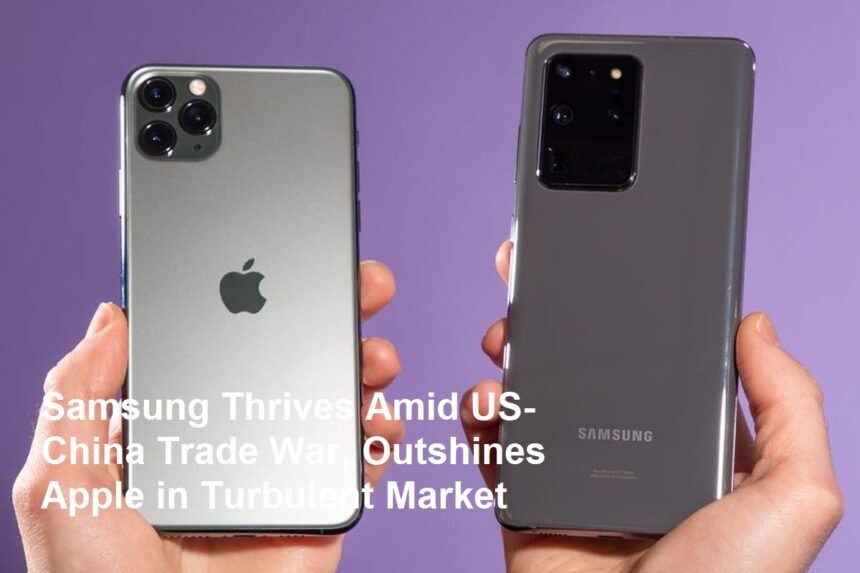
Samsung Thrives Amid US-China Trade War, Outshines Apple in Turbulent Market

6 Min Read
SHARE

As the US-China trade war reshapes global supply chains, South Korean tech giant Samsung Electronics has emerged as an unexpected winner, reporting robust profits in 2023 despite economic headwinds. Meanwhile, its rival Apple faces mounting challenges, including sluggish sales in China and production bottlenecks, highlighting a stark divergence in fortunes between the two tech titans. Analysts attribute Samsung’s resilience to its diversified manufacturing footprint and agility in navigating tariff disputes, while Apple’s heavy reliance on Chinese suppliers and markets leaves it increasingly vulnerable.

Trade War Fallout: A Tale of Two Strategies
The US-China trade conflict, reignited in recent years by tariffs on semiconductors, electronics, and critical components, has forced multinational firms to rethink their supply chains. Samsung, which began decentralizing production a decade ago, now operates factories in Vietnam, India, and South Korea, minimizing exposure to China. In contrast, Apple remains deeply entrenched in Chinese manufacturing, with over 90% of its products assembled there by contractors like Foxconn. This contrast has proven pivotal as geopolitical tensions escalate.

In 2023, the US expanded restrictions on advanced semiconductor exports to China, while Beijing retaliated with bans on American tech firms and tightened scrutiny over foreign manufacturers. Samsung, less dependent on either market for production, sidestepped the worst of these measures. Its semiconductor division, bolstered by demand for AI chips and memory solutions, saw Q3 profits jump 18% year-on-year to $4.6 billion. Meanwhile, Apple’s revenue in Greater China plummeted 12% in the same quarter, reflecting weakened consumer sentiment and rising competition from domestic brands like Huawei.

Samsung’s Supply Chain Agility Pays Off
Samsung’s strategic investments in Southeast Asia have insulated it from tariff-related disruptions. Since 2014, the company has poured $18 billion into Vietnam, which now accounts for 60% of its smartphone output. This shift allowed Samsung to avoid US tariffs targeting Chinese-made electronics, which can reach 25% for certain components. Additionally, India’s production-linked incentive (PLI) scheme for electronics manufacturers enabled Samsung to expand its Chennai plant, securing tariff exemptions on devices sold domestically and exported to Europe.

The company also capitalized on China’s tech slowdown. With Huawei constrained by US sanctions, Samsung regained ground in premium smartphone markets across Europe and Latin America. Its Galaxy S23 series, featuring chipsets produced in-house and in US-allied South Korea, faced no export restrictions, unlike Apple’s China-dependent iPhone 15.

Apple’s China Conundrum
Apple’s challenges underscore the risks of overreliance on a single region. Despite efforts to diversify—such as shifting some iPad production to Vietnam—the company remains tethered to China for iPhone assembly. Recent COVID-19 lockdowns in Zhengzhou, home to Foxconn’s largest iPhone factory, caused severe delays, costing Apple an estimated $6 billion in lost sales in late 2022.

Moreover, Beijing’s push for tech self-sufficiency has emboldened local rivals. Huawei’s surprise launch of the Mate 60 Pro, powered by a domestically produced 7nm chip, has reignited patriotic buying in China, eroding Apple’s market share. Concurrently, Chinese government agencies and state-owned enterprises have begun restricting iPhone use among employees, citing security concerns—a move interpreted as retaliation against US semiconductor curbs.

Semiconductor Supremacy: A Decisive Edge
Samsung’s vertically integrated supply chain, particularly in semiconductors, provides another advantage. As the world’s largest memory chipmaker, it supplies not only its own devices but also competitors, including Apple. The US-CHIPS Act, which allocates $52 billion to bolster American semiconductor production, has further benefited Samsung, which is expanding its Texas-based chip foundries. In contrast, Apple’s dependency on TSMC—whose advanced fabs are concentrated in Taiwan—exposes it to cross-strait tensions and potential supply shocks.

Market Reactions and Future Outlook
Investors have rewarded Samsung’s strategic positioning, with shares rising 24% in 2023 compared to Apple’s 7% gain. “Samsung’s ability to pivot amid geopolitical shifts is a masterclass in risk management,” said Lee Jae-yun, an analyst at Yuanta Securities Korea. “Apple must accelerate its diversification efforts or risk further erosion.”

Looking ahead, Samsung aims to leverage its lead in AI-driven devices and foldable smartphones, a niche where it dominates with 80% market share. Apple, meanwhile, is reportedly fast-tracking plans to move 25% of iPhone production to India by 2025, though analysts caution that replicating China’s scale and efficiency will take years.

Conclusion: Adaptation as the New Imperative
The US-China trade war has underscored a critical lesson for tech giants: flexibility is survival. Samsung’s proactive supply chain decentralization and semiconductor autonomy have positioned it to thrive in an era of fragmentation. For Apple, long-celebrated for its seamless integration, the path forward demands painful but necessary recalibration. As tariffs and tech cold wars redefine global trade, the ability to adapt—not just innovate—will separate the winners from the losers.


bankingfortunes.com
Share This Article
Twitter Email Copy Link Print
Previous Article The Impending Catastrophe: Israel’s Blockade and the Specter of Mass Starvation in Gaza
Next Article Spain Cancels Controversial $7.5 Million Ammunition Deal with Israel Amid Political Backlash
Leave a comment

Leave a Reply Cancel reply

Your email address will not be published. Required fields are marked *

World Wide

Asset Management

Example of Implementing Sales Enablement

Sales Enablement is a strategic approach that aims to increase the efficiency and effectiveness of the sales process by providing…

World

Vatican Declares Nine-Day Period of Mourning for Pope Francis Beginning April 26

VATICAN CITY — The Vatican announced on Thursday that it will observe a nine-day period of mourning for Pope Francis,…

Financial Context

Definition of Tainted Property

Tainted property refers to property or assets obtained through illegal or unethical activities and generally prevented from being used in…

Trending On

Kawasaki Unveils Ninja H2 Hyse: The World’s First Liquid Hydrogen-Powered Motorcycle

Kawasaki has officially launched the Ninja H2 Hyse, marking a groundbreaking milestone in the motorcycle…

Bitcoin Price Remains Stable Amid Global Economic Uncertainty

In the midst of ongoing global economic uncertainty, Bitcoin has demonstrated remarkable price stability, defying…

Pakistan Closes Airspace in Response to Indian Missile Strikes on Key Airbases

On Saturday, May 10, 2025, Pakistan took the significant step of closing its entire airspace…

IMF Confident Global Economy Will Avoid Recession Despite Trump’s Tariff Impact

The International Monetary Fund (IMF) has recently expressed cautious optimism that the global economy will…

Brazil’s Foreign Minister Urges BRICS to Define a Unified Position Amid Global Trade Tariff Conflicts

In a significant diplomatic gathering held in Rio de Janeiro, Brazil’s Foreign Minister Mauro Vieira…

Understanding Sharia Economics and Conventional Economics

Sharia economics is an economic system whose principles and operations are based on Islamic law…

Thousands Pay Nocturnal Tribute as Pope Francis Lies in State at St. Peter’s Basilica

VATICAN CITY — In a profound display of reverence, nearly 20,000 pilgrims gathered under the…

Essential List of Prohibited Items on Flights You Need to Know

Traveling by air requires awareness of certain restrictions to ensure safety and compliance with airline…

Black Smoke Signals No New Pope Yet as Papal Conclave Continues on May 8, 2025

On Wednesday, May 7, 2025, the first day of the papal conclave voting took place…

Financial Context

How Unit Linked Insurance Plans (ULIP) Work

Definition and Introduction of ULIP Unit Linked Insurance Plan (ULIP) is a revolutionary insurance product that combines life insurance with…

8 Min Read
TechnologyWorld

Chinese-Made Chengdu J-10 and PL-15 Missile Gain Spotlight After Pakistan’s Alleged Success Against French Rafale and Russian Su-30 Jets

Recent reports have thrust China’s Chengdu J-10 fighter jet and PL-15 missile into the international spotlight following allegations that Pakistan…

6 Min Read
Asset Management

Measuring Depreciation Adequacy

Definition of Depreciation Adequacy Depreciation adequacy is an important concept in the financial sector related to asset management and company…

9 Min Read
Government Fund

Example of a Forex Transaction with Base Currency

Definition of Base Currency Base currency is the currency that is used as a reference in Forex trading and is…

9 Min Read
PoliticsWorld

India and Pakistan Agree to Ceasefire Following U.S. Mediation

On May 10, 2025, a significant development unfolded in the long-standing conflict between India and Pakistan, as both nations agreed…

5 Min Read
EconomyPoliticsWorld

Pakistan Closes Airspace in Response to Indian Missile Strikes on Key Airbases

On Saturday, May 10, 2025, Pakistan took the significant step of closing its entire airspace following a series of missile…

7 Min Read
Politics

India Downgrades Diplomatic Mission, Recalls Staff After Deadly Kashmir Attack

India announced a series of diplomatic measures against Pakistan on Thursday in response to a deadly militant attack on civilians…

5 Min Read
PoliticsWorld

Zelensky Honors War Heroes with European Leaders

On May 10, 2025, a solemn and significant ceremony took place at Independence Square in Kyiv, Ukraine, where President Volodymyr…

6 Min Read
bankingfortunes.com
Facebook Twitter Youtube Rss Medium

Greetings to you

BankingFortunes: Your instant connection to breaking stories and live updates. Stay informed with our real-time coverage across politics, tech, business, and more. Your reliable source for 24/7 news.

Top Categories
  • About Us
  • Contact Us
  • Privacy Policy
  • Terms of Use
  • Economic Policies
  • Investment Market
  • Financial Context
  • World
  • Politics
  • Sports
  • Economy
  • Technology
  • Health
  • Asset Management

Address

Bahnhofstrasse 26A, 8001 Zürich, Switzerland. +41 44 220 15 17

© BankingFortunes Network.  2019 – 2025. All Rights Reserved.

Welcome Back!

Sign in to your account

Lost your password?