


• Home
  • About Us
  • Contact
  • Term Of Use
  • Privacy Policy
Subscribe
bankingfortunes.com
  • Home
  • Economic Policies
  • Investment Market
  • Financial Context
  • Asset Management
  • Politics
  • Sports
  • Technology
  • Health
  • Contact Us
    • Terms of Use
    • About Us
    • Privacy Policy
🔥
  • Top stories
Aa
bankingfortunes.combankingfortunes.com
  • My Saves
  • My Interests
  • My Feed
  • History
Search
  • Pages
    • Home
    • Blog Index
    • Contact Us
    • Search Page
    • 404 Page
  • Home
    • Home 1
    • Home 2
    • Home 3
    • Home 4
    • Home 5
  • Home
    • Home 1
    • Home 2
    • Home 3
    • Home 4
    • Home 5
  • Home
    • Home 1
    • Home 2
    • Home 3
    • Home 4
    • Home 5
  • Home
  • Home
  • Categories
  • Categories
  • Demos
  • Personalized
    • My Feed
    • My Saves
    • My Interests
    • History
  • Demos
  • Demos
  • More Foxiz
    • Blog Index
    • Forums
    • Complaint
    • Sitemap
  • Categories
  • More Foxiz
    • Blog Index
    • Forums
    • Complaint
    • Sitemap
  • Categories
  • Categories
  • Categories
  • Bookmarks
  • Bookmarks
  • Bookmarks
  • More Foxiz
    • Sitemap
  • More Foxiz
    • Sitemap
  • More Foxiz
    • Sitemap
Have an existing account? Sign In
Follow US
© 2022 Foxiz News Network. Ruby Design Company. All Rights Reserved.
bankingfortunes.com > Blog > Economy > U.S.-China Agree to 90-Day Trade War Ceasefire with Significant Tariff Cuts
EconomyPoliticsWorld

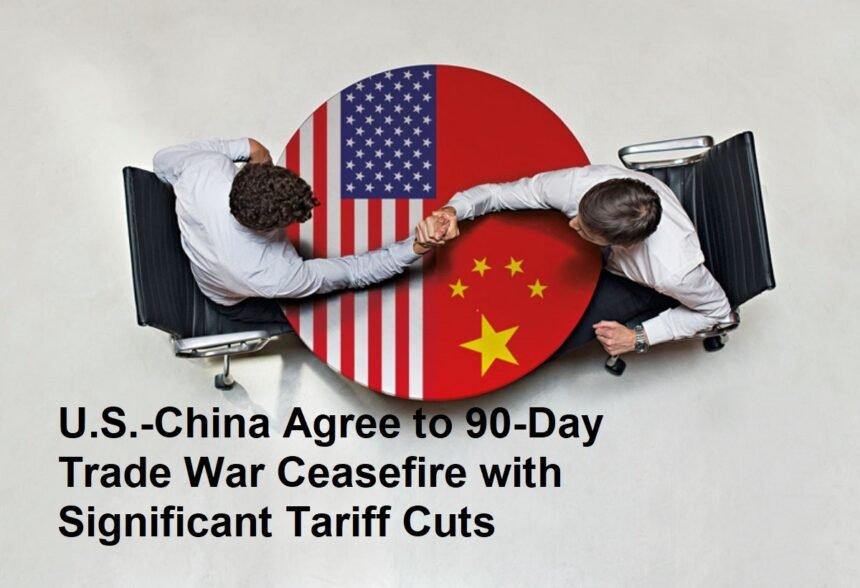
U.S.-China Agree to 90-Day Trade War Ceasefire with Significant Tariff Cuts

6 Min Read
SHARE

On May 13, 2025, the United States and China reached a landmark agreement to implement a 90-day ceasefire in their ongoing trade war, marking a significant step toward easing tensions between the world’s two largest economies. This temporary truce involves substantial reductions in the additional tariffs each country has imposed on the other’s goods, with the United States agreeing to lower its extra tariffs on Chinese products from 145 percent to 30 percent, while China will reduce its additional tariffs on American goods from 125 percent to 10 percent. This agreement not only signals a mutual willingness to de-escalate economic hostilities but also opens a critical window for both nations to negotiate a more comprehensive and lasting trade deal.

The trade conflict between the United States and China has been one of the most consequential economic disputes of the 21st century. It began in earnest in 2018, when the U.S. administration, citing unfair trade practices, intellectual property theft, and a large trade deficit, imposed sweeping tariffs on Chinese imports. China responded in kind, leading to a tit-for-tat escalation that disrupted global supply chains, increased costs for businesses and consumers, and injected uncertainty into international markets. Over the years, the tariff rates climbed to unprecedented levels, with the U.S. imposing additional tariffs as high as 145 percent on certain Chinese goods, and China retaliating with tariffs up to 125 percent on American products.

The newly agreed 90-day ceasefire represents a strategic pause in this escalating conflict. By significantly lowering the additional tariffs, both countries aim to reduce the economic strain on their industries and consumers while creating a more conducive environment for dialogue. The U.S. reduction from 145 percent to 30 percent and China’s cut from 125 percent to 10 percent are substantial concessions, though the tariffs remain above normal levels. These reductions are designed to provide immediate relief and build trust as negotiators work toward resolving deeper structural issues.

This ceasefire is not merely about tariff numbers; it reflects a broader recognition of the interconnectedness of the global economy and the risks posed by prolonged trade hostilities. For businesses, the agreement offers a reprieve from the unpredictability that has hampered investment and planning. For consumers, it may translate into lower prices and more stable product availability. Financial markets have responded positively to the news, with stock indices and commodity prices showing signs of relief after months of volatility.

However, the agreement also underscores the complexity of the U.S.-China trade relationship. The core disputes extend beyond tariffs to include intellectual property rights, technology transfer policies, market access, and state subsidies. These issues have proven difficult to resolve and require detailed negotiations that go beyond the scope of a temporary tariff reduction. The 90-day period is thus a critical window for both sides to engage in substantive talks, with the hope of reaching a comprehensive agreement that addresses these fundamental concerns.

From the U.S. perspective, the tariff reductions are a tactical move to maintain leverage while signaling openness to compromise. American officials have emphasized the need for enforceable commitments from China to protect intellectual property and ensure fair trade practices. Meanwhile, China views the ceasefire as an opportunity to stabilize its economy, which has faced headwinds from the trade war, and to demonstrate its willingness to engage constructively on the world stage.

The international community has welcomed the ceasefire as a positive development. Other major economies, which have been affected by the ripple effects of the U.S.-China trade tensions, see this as a step toward restoring global economic stability. Organizations such as the World Trade Organization (WTO) have expressed hope that the dialogue will lead to a rules-based resolution that strengthens the multilateral trading system.

Despite the optimism, challenges remain. The short duration of the ceasefire means that both countries must act swiftly and in good faith to make meaningful progress. Past negotiations have often stalled due to mistrust and conflicting interests. Moreover, domestic political pressures in both countries could influence the pace and scope of concessions. The global economic environment, including inflationary pressures and supply chain disruptions, adds further complexity to the negotiations.

In conclusion, the 90-day trade ceasefire agreement between the United States and China, featuring significant tariff reductions, represents a hopeful but cautious step toward resolving one of the most significant economic conflicts of recent times. It offers a temporary easing of tensions and a platform for dialogue, but the ultimate success depends on the ability of both nations to address the underlying structural issues that have fueled the dispute. The world watches closely as these two economic giants embark on this critical period of negotiation, hopeful that it will lead to a more stable and cooperative global trade environment.

bankingfortunes.com
Share This Article
Twitter Email Copy Link Print
Previous Article José Mujica, Uruguay’s ‘Poorest President,’ Dies at 89 After Battling Cancer
Next Article Global Markets Rally as U.S.-China Trade Ceasefire Boosts Dollar and Stocks
Leave a comment

Leave a Reply Cancel reply

Your email address will not be published. Required fields are marked *

World Wide

World

Cardinals Gather in Vatican for Historic 267th Papal Conclave Amid Global Challenges

Vatican City – May 7, 2025: Cardinals from across the globe convened in Rome on Tuesday to commence the 267th…

Health

Three Types of Leaves That Support Bone Health and Are Ideal for Aging Individuals

As people age, maintaining strong and healthy bones becomes increasingly important to prevent conditions such as osteoporosis and fractures. Nutrition…

EconomyWorld

3 Data-Driven Strategies to Decode Consumer Behavior and Skyrocket Sales

Introduction In today’s hypercompetitive market, understanding consumer behavior is the cornerstone of boosting sales and achieving sustained business growth. With…

Trending On

The Diplomatic Nuance of Representation: Joko Widodo Attending a Papal Funeral in Rome

The potential delegation of former Indonesian President Joko Widodo by incumbent President Prabowo Subianto to…

China Set to Unveil World’s Highest Bridge in Guizhou’s Grand Canyon, Redefining Engineering Limits

Huanjiang, Guizhou Province – May 15, 2025: In a landmark achievement for infrastructure development, China…

Introduction to the Greenback and USD

Greenback is a term originating in the United States to designate dollar bills that began…

China’s FM Wang Yi Urges Indonesia’s Sugiono to Jointly Oppose Unilateralism

On Monday, April 21, 2025, at a joint press conference following the inaugural “2+2” ministerial…

China Develops Wireless Smart NanoFluid Patch to Treat Cancer

Chinese researchers have made a groundbreaking advancement in medical technology by creating a wireless smart…

Leaked Meeting Reveals Netanyahu’s Controversial Remarks on Gaza Attack as a Step to Expel Palestinians

  On Sunday, May 11, 2025, Israeli Prime Minister Benjamin Netanyahu held a confidential meeting…

Global Economy Faces Grim Outlook as 48 Countries Turn to IMF for Support

The global economic landscape is increasingly bleak, with mounting challenges pushing nearly 48 countries to…

British Airways’ £100 Million AI Investment Drives Dramatic Improvement in Flight Punctuality

British Airways, one of the world’s leading airlines, has recently announced that its substantial investment…

COVID-19 Resurgence Hits Hong Kong Hard: 30 Deaths and Rising Cases Spark Concern

Hong Kong is currently facing a significant resurgence of COVID-19 infections, with health authorities reporting…

TechnologyWorld

China Unveils Jiu Tian: The Versatile Mother Drone for Tactical Operations and Drone Swarms

China has recently introduced a groundbreaking unmanned aerial vehicle (UAV) known as the Jiu Tian, or "High Sky," which represents…

6 Min Read
World

Massive Wildfires Engulf Central Israel, Threaten Jerusalem

A devastating wildfire erupted in central Israel on , rapidly spreading across dry landscapes and threatening communities near Jerusalem. The…

5 Min Read
Politics

Pakistan Repatriates Indian Border Guard Following Deadly Kashmir Attack and Escalated Military Tensions

On Wednesday, May 14, 2025, Pakistan repatriated an Indian border guard who had been detained following a deadly attack in…

4 Min Read
Financial Context

Understanding Sharia Economics and Conventional Economics

Sharia economics is an economic system whose principles and operations are based on Islamic law or Sharia. The uniqueness of…

10 Min Read
TechnologyWorld

Shanghai Streets Filled with Unitree Go2 Robot Dogs: A Sign of China’s Rapid Robotics and AI Progress

In recent months, the streets of Shanghai have witnessed an unusual yet fascinating sight: Unitree Go2 robot dogs autonomously walking…

4 Min Read
SportsWorld

Epic Showdown at San Mamés: Tottenham Hotspur vs Manchester United in the 2024/25 UEFA Europa League Final

The Venue: San Mamés Stadium, Bilbao, Spain The historic San Mamés Stadium in Bilbao, Spain, is set to host the…

6 Min Read
TechnologyWorld

Why Airplane Windows Are Oval-Shaped: Key Reasons Explained

Airplane windows have a distinctive oval or rounded shape, a design choice that might seem purely aesthetic but actually serves…

5 Min Read
World

Istanbul Shaken by Magnitude 6.2 Earthquake: A Preliminary Assessment

On Thursday, April 23, 2025, Istanbul, Turkey, experienced a significant seismic event as a magnitude 6.2 earthquake struck the region…

4 Min Read
bankingfortunes.com
Facebook Twitter Youtube Rss Medium

Greetings to you

BankingFortunes: Your instant connection to breaking stories and live updates. Stay informed with our real-time coverage across politics, tech, business, and more. Your reliable source for 24/7 news.

Top Categories
  • About Us
  • Contact Us
  • Privacy Policy
  • Terms of Use
  • Economic Policies
  • Investment Market
  • Financial Context
  • World
  • Politics
  • Sports
  • Economy
  • Technology
  • Health
  • Asset Management

Address

Bahnhofstrasse 26A, 8001 Zürich, Switzerland. +41 44 220 15 17

© BankingFortunes Network.  2019 – 2025. All Rights Reserved.

Welcome Back!

Sign in to your account

Lost your password?