


• Home
  • About Us
  • Contact
  • Term Of Use
  • Privacy Policy
Subscribe
bankingfortunes.com
  • Home
  • Economic Policies
  • Investment Market
  • Financial Context
  • Asset Management
  • Politics
  • Sports
  • Technology
  • Health
  • Contact Us
    • Terms of Use
    • About Us
    • Privacy Policy
🔥
  • Top stories
Aa
bankingfortunes.combankingfortunes.com
  • My Saves
  • My Interests
  • My Feed
  • History
Search
  • Pages
    • Home
    • Blog Index
    • Contact Us
    • Search Page
    • 404 Page
  • Home
    • Home 1
    • Home 2
    • Home 3
    • Home 4
    • Home 5
  • Home
    • Home 1
    • Home 2
    • Home 3
    • Home 4
    • Home 5
  • Home
    • Home 1
    • Home 2
    • Home 3
    • Home 4
    • Home 5
  • Home
  • Home
  • Categories
  • Categories
  • Demos
  • Personalized
    • My Feed
    • My Saves
    • My Interests
    • History
  • Demos
  • Demos
  • More Foxiz
    • Blog Index
    • Forums
    • Complaint
    • Sitemap
  • Categories
  • More Foxiz
    • Blog Index
    • Forums
    • Complaint
    • Sitemap
  • Categories
  • Categories
  • Categories
  • Bookmarks
  • Bookmarks
  • Bookmarks
  • More Foxiz
    • Sitemap
  • More Foxiz
    • Sitemap
  • More Foxiz
    • Sitemap
Have an existing account? Sign In
Follow US
© 2022 Foxiz News Network. Ruby Design Company. All Rights Reserved.
bankingfortunes.com > Blog > Politics > EU Doubts Putin’s Willingness to Meet Zelensky in Istanbul Peace Talks
Politics

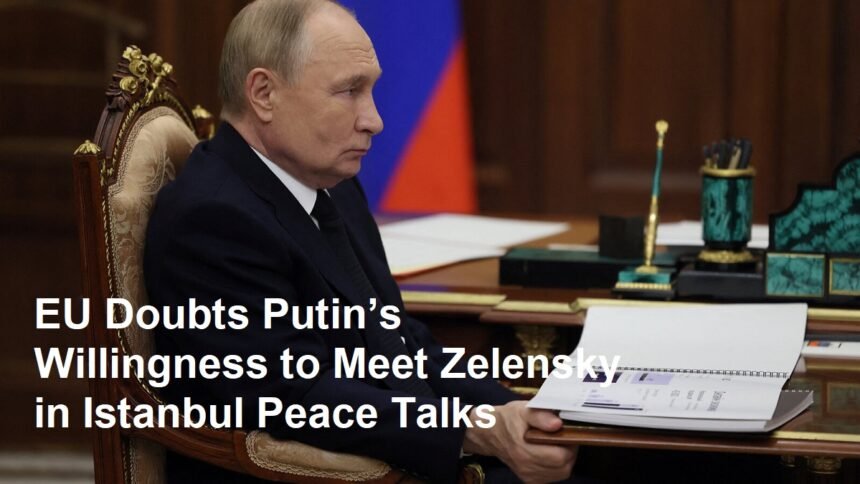
EU Doubts Putin’s Willingness to Meet Zelensky in Istanbul Peace Talks

6 Min Read
SHARE

The European Union (EU) has recently expressed a critical assessment regarding the upcoming peace negotiations scheduled to take place in Istanbul, Turkey, on May 15, 2025, between Russian President Vladimir Putin and Ukrainian President Volodymyr Zelensky. According to EU officials and diplomatic sources, there is a prevailing belief that President Putin may not have the willingness or courage to engage directly with President Zelensky in these high-stakes talks. This perspective sheds light on the complex dynamics surrounding the ongoing conflict between Russia and Ukraine and the challenges facing international efforts to broker peace.

The planned meeting in Istanbul has been widely anticipated as a potential breakthrough in the protracted and devastating conflict that has gripped Eastern Europe for years. The war has resulted in significant human suffering, displacement, and geopolitical instability, drawing intense international attention and prompting numerous diplomatic initiatives. The EU, as a key stakeholder in regional security and a supporter of Ukraine’s sovereignty, has been actively involved in facilitating dialogue and applying pressure for a peaceful resolution.

However, the EU’s assessment that Putin may shy away from a direct encounter with Zelensky reflects deep-seated concerns about Russia’s commitment to genuine negotiations. Several factors contribute to this skepticism. First, the longstanding mistrust between the two leaders and their respective governments complicates any prospect of face-to-face dialogue. Putin’s administration has often portrayed Zelensky’s government as illegitimate or influenced by Western powers, while Zelensky has accused Russia of aggression and violations of international law. This mutual distrust creates a formidable barrier to constructive engagement.

Second, the EU points to Russia’s strategic calculations and domestic political considerations. Putin’s leadership has been characterized by a strong emphasis on projecting strength and maintaining control over the narrative surrounding the conflict. Agreeing to meet Zelensky directly could be perceived domestically as a concession or sign of weakness, potentially undermining Putin’s political standing. Moreover, Russia’s broader geopolitical ambitions in the region may not align with the compromises necessary for a lasting peace agreement.

Third, the EU highlights the pattern of previous diplomatic efforts where Russia has shown reluctance or employed delaying tactics. Past negotiations have often been marked by missed opportunities, ambiguous commitments, and unilateral actions that have undermined trust. This history fuels doubts about the sincerity of Russia’s engagement in the Istanbul talks and raises questions about whether the meeting will result in substantive progress.

From the EU’s perspective, Putin’s potential absence or refusal to meet Zelensky directly could have significant implications. It risks undermining the credibility and effectiveness of the peace process, leaving Ukraine and the international community in a state of uncertainty. Without direct dialogue between the principal leaders, negotiations may be relegated to lower-level officials or intermediaries, which could limit the scope and impact of any agreements reached.

Furthermore, the EU is concerned about the message such a refusal would send to the global community. It could be interpreted as a lack of commitment to resolving the conflict peacefully and a disregard for diplomatic norms. This perception might embolden further aggressive actions or prolong the hostilities, exacerbating the humanitarian crisis and destabilizing the region further.

Despite these concerns, the EU remains committed to supporting Ukraine and facilitating dialogue wherever possible. The union continues to provide political, economic, and humanitarian assistance to Ukraine and works closely with international partners to maintain pressure on Russia to engage constructively. The EU also emphasizes the importance of upholding international law, respecting sovereignty, and protecting human rights as foundational principles guiding its approach.

Ukrainian President Zelensky, for his part, has expressed readiness to engage in talks and pursue peace, even under challenging circumstances. His willingness to meet in Istanbul signals a pragmatic approach aimed at ending the conflict and alleviating the suffering of the Ukrainian people. The EU supports this stance and encourages all parties to seize the opportunity for dialogue.

In conclusion, the European Union’s assessment that President Vladimir Putin may lack the courage or willingness to meet President Volodymyr Zelensky in the Istanbul peace negotiations underscores the profound difficulties facing the resolution of the Russia-Ukraine conflict. The EU’s concerns reflect a broader context of mistrust, strategic calculations, and political complexities that complicate diplomatic efforts. While the outcome of the May 15 talks remains uncertain, the EU’s position highlights the critical need for genuine engagement and leadership commitment to achieve a sustainable and just peace. The international community continues to watch closely, hopeful that despite the challenges, dialogue can pave the way toward ending one of the most pressing conflicts of our time.


 

bankingfortunes.com
Share This Article
Twitter Email Copy Link Print
Previous Article Trump Considers Attending Putin-Zelensky Talks in Turkey
Next Article José Mujica, Uruguay’s ‘Poorest President,’ Dies at 89 After Battling Cancer
Leave a comment

Leave a Reply Cancel reply

Your email address will not be published. Required fields are marked *

World Wide

Investment Market

Seller’s responsibility in Cost and Freight (CFR)

Definition of Cost and Freight (CFR) Cost and Freight (CFR) is a term used in international trade to state the…

Economic Policies

Financial Modeling Test

Financial modeling test is a financial analysis process that involves creating a mathematical model that describes the financial performance of…

Asset Management

The Role of Quote Currency in Transactions

Understanding Quote Currency Understanding quote currency is an important concept in the world of trading, especially in the foreign exchange…

Trending On

India and Pakistan Agree to Ceasefire Following U.S. Mediation

On May 10, 2025, a significant development unfolded in the long-standing conflict between India and…

China’s New Deep-Sea Cable Cutter: A Game-Changing Weapon Capable of Severing Undersea Communication Infrastructure at 4000 Meters Depth

China has unveiled a powerful new weapon designed to cut underwater communication cables at depths…

Safe Tips During and After an Earthquake

Earthquakes can strike suddenly and without warning, causing significant damage and danger. Knowing how to…

IMF Confident Global Economy Will Avoid Recession Despite Trump’s Tariff Impact

The International Monetary Fund (IMF) has recently expressed cautious optimism that the global economy will…

Peruvian National Team Welcomes the Election of Cardinal Robert Francis Prevost as Pope Leo XIV

In a remarkable and historic moment for the global Catholic community, Cardinal Robert Francis Prevost…

Brazil’s Foreign Minister Urges BRICS to Define a Unified Position Amid Global Trade Tariff Conflicts

In a significant diplomatic gathering held in Rio de Janeiro, Brazil’s Foreign Minister Mauro Vieira…

Russia Displays Tanks, Missiles, and Fighter Jets in Moscow’s 2025 Victory Day Parade

On May 9, 2025, Moscow hosted its annual Victory Day Parade, a grand and highly…

Kawasaki Unveils Ninja H2 Hyse: The World’s First Liquid Hydrogen-Powered Motorcycle

Kawasaki has officially launched the Ninja H2 Hyse, marking a groundbreaking milestone in the motorcycle…

Israeli Democratic Party Leader Yair Golan Condemns Netanyahu’s Brutal Gaza Offensive Amid Rising Palestinian Casualties

On Tuesday, May 20, 2025, Yair Golan, the Chairman of Israel’s Democratic Party, delivered a…

Economic Policies

The Three Elements of the Blockchain Trilemma

The Blockchain Trilemma is a concept that describes three main, interrelated aspects of blockchain technology, namely decentralization, security and scalability.…

9 Min Read
PoliticsWorld

North Korea Introduces New Destroyer-Class Warship ‘Choe Hyon’ and Conducts Missile Test

North Korea has unveiled a significant advancement in its naval capabilities with the introduction of a new warship class named…

5 Min Read
Health

Celery’s Role in Kidney Health: Benefits and How to Consume It

Celery is a popular vegetable known not only for its crisp texture and refreshing taste but also for its numerous…

6 Min Read
TechnologyWorld

China’s LandSpace Successfully Launches Methane-Powered Zhuque-2E Y2 Rocket, Deploying Six Satellites into Orbit

On May 17, 2025, China’s private aerospace company LandSpace Technology achieved a significant milestone by successfully launching its methane-powered Zhuque-2E…

4 Min Read
Asset Management

Example of Implementing Sales Enablement

Sales Enablement is a strategic approach that aims to increase the efficiency and effectiveness of the sales process by providing…

8 Min Read
Blog

Israel to Mobilize 10,000 Reserve Troops for New Offensive

In response to escalating tensions and ongoing conflict, Israel has announced plans to mobilize 10,000 reserve soldiers to launch a…

3 Min Read
World

China Set to Unveil World’s Highest Bridge in Guizhou’s Grand Canyon, Redefining Engineering Limits

Huanjiang, Guizhou Province – May 15, 2025: In a landmark achievement for infrastructure development, China is poised to officially open…

5 Min Read
EconomyWorld

Nissan Motor Announces 20,000 Job Cuts Amid $4.5 Billion Net Loss and Restructuring Plan

Nissan Motor Company, one of the world’s leading automobile manufacturers, has recently announced a significant restructuring plan in response to…

6 Min Read
bankingfortunes.com
Facebook Twitter Youtube Rss Medium

Greetings to you

BankingFortunes: Your instant connection to breaking stories and live updates. Stay informed with our real-time coverage across politics, tech, business, and more. Your reliable source for 24/7 news.

Top Categories
  • About Us
  • Contact Us
  • Privacy Policy
  • Terms of Use
  • Economic Policies
  • Investment Market
  • Financial Context
  • World
  • Politics
  • Sports
  • Economy
  • Technology
  • Health
  • Asset Management

Address

Bahnhofstrasse 26A, 8001 Zürich, Switzerland. +41 44 220 15 17

© BankingFortunes Network.  2019 – 2025. All Rights Reserved.

Welcome Back!

Sign in to your account

Lost your password?