


• Home
  • About Us
  • Contact
  • Term Of Use
  • Privacy Policy
Subscribe
bankingfortunes.com
  • Home
  • Economic Policies
  • Investment Market
  • Financial Context
  • Asset Management
  • Politics
  • Sports
  • Technology
  • Health
  • Contact Us
    • Terms of Use
    • About Us
    • Privacy Policy
🔥
  • Top stories
Aa
bankingfortunes.combankingfortunes.com
  • My Saves
  • My Interests
  • My Feed
  • History
Search
  • Pages
    • Home
    • Blog Index
    • Contact Us
    • Search Page
    • 404 Page
  • Home
    • Home 1
    • Home 2
    • Home 3
    • Home 4
    • Home 5
  • Home
    • Home 1
    • Home 2
    • Home 3
    • Home 4
    • Home 5
  • Home
    • Home 1
    • Home 2
    • Home 3
    • Home 4
    • Home 5
  • Home
  • Home
  • Categories
  • Categories
  • Demos
  • Personalized
    • My Feed
    • My Saves
    • My Interests
    • History
  • Demos
  • Demos
  • More Foxiz
    • Blog Index
    • Forums
    • Complaint
    • Sitemap
  • Categories
  • More Foxiz
    • Blog Index
    • Forums
    • Complaint
    • Sitemap
  • Categories
  • Categories
  • Categories
  • Bookmarks
  • Bookmarks
  • Bookmarks
  • More Foxiz
    • Sitemap
  • More Foxiz
    • Sitemap
  • More Foxiz
    • Sitemap
Have an existing account? Sign In
Follow US
© 2022 Foxiz News Network. Ruby Design Company. All Rights Reserved.
bankingfortunes.com > Blog > Technology > Comparative Analysis of the United States’ Golden Dome and Israel’s Iron Dome Missile Defense Systems
TechnologyWorld

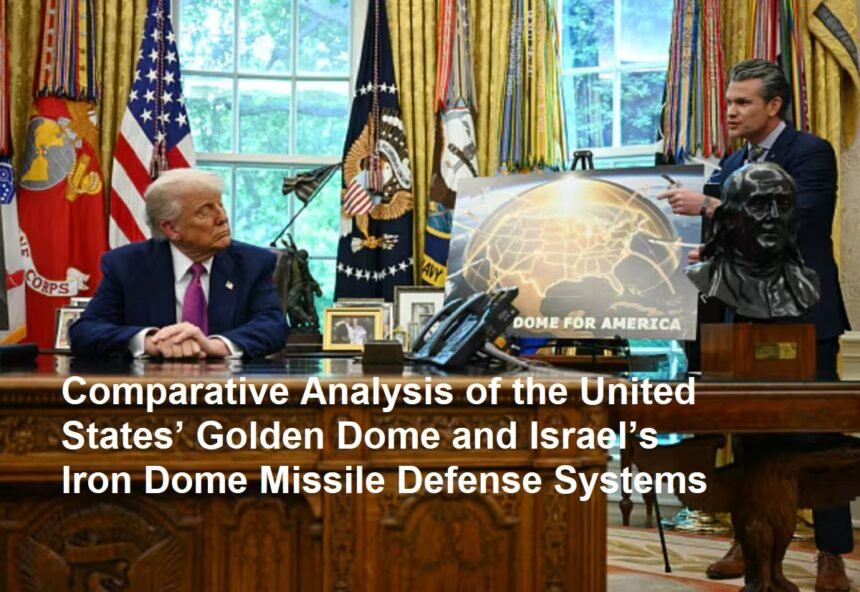
Comparative Analysis of the United States’ Golden Dome and Israel’s Iron Dome Missile Defense Systems

5 Min Read
SHARE

Missile defense systems have become critical components in modern military strategies, particularly for nations facing persistent threats from missile attacks. Two notable systems— the United States’ Golden Dome and Israel’s Iron Dome— demonstrate advanced technological responses designed to intercept and neutralize incoming projectiles. Despite their shared fundamental purpose of missile interception, these systems differ significantly in design, deployment, operational scope, and strategic intent. This essay elaborates on the key differences between the Golden Dome system owned by the United States and the Iron Dome system operated by Israel, highlighting their respective capabilities, technological frameworks, and operational contexts.

First and foremost, the Iron Dome system, developed by Israel, is recognized globally for its operational success and real-time response to short-range rocket threats. Deployed since 2011, the Iron Dome was specifically created to protect Israeli civilian populations and critical infrastructure from rockets and artillery shells emanating primarily from Gaza and neighboring regions. The system is unique in its ability to analyze incoming threats’ trajectory and determine whether the projectile poses a risk to populated areas. If the threat is assessed to be significant, the system launches an interceptor missile to neutralize the projectile mid-air. This selective engagement process maximizes resource efficiency, minimizing unnecessary interceptions and reducing operational costs.

In contrast, the Golden Dome system is a more recent American development, reportedly designed to enhance protection against a broader range of aerial threats, including ballistic missiles and possibly hypersonic weapons. While information about the Golden Dome remains less publicly detailed compared to Iron Dome due to its sensitive nature and classified components, reports indicate that it incorporates advanced radar tracking, multi-layered interception capabilities, and integration with other U.S. missile defense frameworks. The Golden Dome is presumably engineered to operate in a wider threat environment, including the possibility of state-sponsored missile strikes with higher velocity and complexity than those typically encountered by Israel.

Technologically, the Iron Dome’s core advantage lies in its cost-effective interceptor missiles and its radar system, which provides real-time data to command-and-control units to make split-second decisions. The interceptor missiles of Iron Dome are relatively small and inexpensive compared to traditional missile defense interceptors, enabling larger quantities to be used during sustained conflicts. The system’s mobility, with transportable launchers, allows for flexible deployment across diverse geographic locations within Israel, adapting to shifts in threat vectors.

Meanwhile, the Golden Dome’s technology is believed to incorporate more advanced radar and sensor fusion technologies, potentially augmented by artificial intelligence for faster target recognition and decision-making processes. Unlike the Iron Dome’s primary focus on short-range threats, the Golden Dome may be part of an integrated layered defense system designed to counter medium to long-range ballistic threats, as well as emerging hypersonic missile challenges. Its interceptors are expected to be larger, more sophisticated, and capable of higher engagement altitudes and speeds. Additionally, the Golden Dome is likely designed to be interoperable with other U.S. missile defense systems such as THAAD (Terminal High Altitude Area Defense) and Aegis ballistic missile defense, creating a comprehensive national defense shield.

From an operational perspective, the Iron Dome system is primarily defensive and localized, focused on protecting relatively small national territories under immediate threat. In contrast, the Golden Dome represents a strategic system integrated into a broader national and international missile defense strategy, reflecting the United States’ global military commitments and wider threat spectrum.

In summary, while both the Golden Dome and Iron Dome systems share the fundamental objective of intercepting and neutralizing aerial threats to safeguard populations and critical assets, they differ in their design philosophy, technological sophistication, operational scope, and strategic deployment. The Iron Dome excels in cost-effective, real-time defense against short-range rockets in a highly volatile regional context, demonstrating unparalleled success in civilian protection in Israel. The United States’ Golden Dome, on the other hand, appears to be a more advanced, multi-layered missile defense system engineered to address diverse, sophisticated threats on a national and global scale. Understanding these differences is essential for appreciating how missile defense technologies evolve to meet the unique security requirements of different nations in an increasingly complex global security environment.


 

bankingfortunes.com
Share This Article
Twitter Email Copy Link Print
Previous Article The Golden Dome America’s Ambitious Missile Defense Dome Set for Completion by 2029
Next Article The Tragic Assassination of Two Aides to Mexico City’s Mayor Implications and Context
Leave a comment

Leave a Reply Cancel reply

Your email address will not be published. Required fields are marked *

World Wide

EconomyWorld

Many Global Airlines Avoid Flying Over South Asia Amid India-Pakistan Conflict

The ongoing conflict between India and Pakistan has led to significant disruptions in international air travel, with numerous global airlines…

Investment Market

Consequences of Zero-Sum Games in Economics

Definition of "Zero-Sum Game" Zero-sum games are a concept in game theory and economics that states that one person's gain…

EconomyTechnologyWorld

Samsung Thrives Amid US-China Trade War, Outshines Apple in Turbulent Market

As the US-China trade war reshapes global supply chains, South Korean tech giant Samsung Electronics has emerged as an unexpected…

Trending On

Kashmiri Exodus via Special Trains Amid Panic

In recent times, reports have emerged about Indian citizens in Kashmir experiencing panic and choosing…

EU Doubts Putin’s Willingness to Meet Zelensky in Istanbul Peace Talks

The European Union (EU) has recently expressed a critical assessment regarding the upcoming peace negotiations…

Putin Declares Surprise Three-Day Ceasefire in Ukraine, Sparks Global Skepticism

Kyiv, Ukraine | Moscow, Russia – May 8, 2025: In an unexpected move, Russian President…

Resurgence of Separatist Movements in Papua, Maluku, and Aceh Draws International Attention

The recent appearance of slogans such as “Free Aceh,” “Free Maluku,” and “Free Papua” at…

Efforts to prevent and overcome distorted prices

Distorted prices refer to the phenomenon where the price of a product or service does…

Understanding Cloud Mining

Cloud mining is a concept that allows individuals to participate in cryptocurrency mining without the…

Trump Visits Qatar to Sign Major Deal for Boeing Aircraft and Advanced MQ-9B Drones

On Wednesday, May 14, 2025, former U.S. President Donald Trump made a high-profile visit to…

Indonesian President Prabowo Subianto Meets Sultan Hassanal Bolkiah at Istana Nurul Iman in Brunei

On Wednesday, May 14, 2025, President Prabowo Subianto of the Republic of Indonesia arrived at…

Manchester United One Step Closer to Champions League Glory After Convincing Europa League Final Win Over Athletic Bilbao

Manchester United has taken a monumental stride toward returning to Europe’s elite club competition, the…

Politics

Trump Insists U.S. Is Serious About Making Canada the 51st State

On April 25, 2025, in an interview with Time magazine, President Donald Trump emphatically stated that he was “really not…

4 Min Read
World

Vietnamese Property Tycoon Truong My Lan’s Life Sentence Reduced to 30 Years in Historic $17 Billion Money Laundering Case

In a landmark ruling, Vietnamese property conglomerate Truong My Lan saw her life sentence commuted to 30 years imprisonment on…

5 Min Read
PoliticsWorld

China Expresses Regret Over India’s Attack on Pakistan and Urges Restraint Amid Escalation

The Chinese government has expressed deep regret and concern over the recent military escalation between India and Pakistan, specifically condemning…

4 Min Read
EconomyPolitics

The Pragmatic Calculus of Closure: Analyzing the Potential Shutdown of the US Consulate in Medan

The escalating discourse surrounding budgetary constraints in the United States government has once again cast a long shadow over international…

4 Min Read
Asset Management

Components and Functions of Querycal Jobs

Introduction to Querycal Jobs In a world surrounded by data, having insight into Querycal Jobs has become a necessity. Querycal…

10 Min Read
Financial Context

How Unit Linked Insurance Plans (ULIP) Work

Definition and Introduction of ULIP Unit Linked Insurance Plan (ULIP) is a revolutionary insurance product that combines life insurance with…

8 Min Read
Blog

Israel to Mobilize 10,000 Reserve Troops for New Offensive

In response to escalating tensions and ongoing conflict, Israel has announced plans to mobilize 10,000 reserve soldiers to launch a…

3 Min Read
EconomyPoliticsWorld

U.S.-China Agree to 90-Day Trade War Ceasefire with Significant Tariff Cuts

On May 13, 2025, the United States and China reached a landmark agreement to implement a 90-day ceasefire in their…

6 Min Read
bankingfortunes.com
Facebook Twitter Youtube Rss Medium

Greetings to you

BankingFortunes: Your instant connection to breaking stories and live updates. Stay informed with our real-time coverage across politics, tech, business, and more. Your reliable source for 24/7 news.

Top Categories
  • About Us
  • Contact Us
  • Privacy Policy
  • Terms of Use
  • Economic Policies
  • Investment Market
  • Financial Context
  • World
  • Politics
  • Sports
  • Economy
  • Technology
  • Health
  • Asset Management

Address

Bahnhofstrasse 26A, 8001 Zürich, Switzerland. +41 44 220 15 17

© BankingFortunes Network.  2019 – 2025. All Rights Reserved.

Welcome Back!

Sign in to your account

Lost your password?