
• Home
  • About Us
  • Contact
  • Term Of Use
  • Privacy Policy
Subscribe
bankingfortunes.com
  • Home
  • Economic Policies
  • Investment Market
  • Financial Context
  • Asset Management
  • Politics
  • Sports
  • Technology
  • Health
  • Contact Us
    • Terms of Use
    • About Us
    • Privacy Policy
🔥
  • Top stories
Aa
bankingfortunes.combankingfortunes.com
  • My Saves
  • My Interests
  • My Feed
  • History
Search
  • Pages
    • Home
    • Blog Index
    • Contact Us
    • Search Page
    • 404 Page
  • Home
    • Home 1
    • Home 2
    • Home 3
    • Home 4
    • Home 5
  • Home
    • Home 1
    • Home 2
    • Home 3
    • Home 4
    • Home 5
  • Home
    • Home 1
    • Home 2
    • Home 3
    • Home 4
    • Home 5
  • Home
  • Home
  • Categories
  • Categories
  • Demos
  • Personalized
    • My Feed
    • My Saves
    • My Interests
    • History
  • Demos
  • Demos
  • More Foxiz
    • Blog Index
    • Forums
    • Complaint
    • Sitemap
  • Categories
  • More Foxiz
    • Blog Index
    • Forums
    • Complaint
    • Sitemap
  • Categories
  • Categories
  • Categories
  • Bookmarks
  • Bookmarks
  • Bookmarks
  • More Foxiz
    • Sitemap
  • More Foxiz
    • Sitemap
  • More Foxiz
    • Sitemap
Have an existing account? Sign In
Follow US
© 2022 Foxiz News Network. Ruby Design Company. All Rights Reserved.
bankingfortunes.com > Blog > Politics > Resurgence of Separatist Movements in Papua, Maluku, and Aceh Draws International Attention
PoliticsWorld

Resurgence of Separatist Movements in Papua, Maluku, and Aceh Draws International Attention

6 Min Read
SHARE

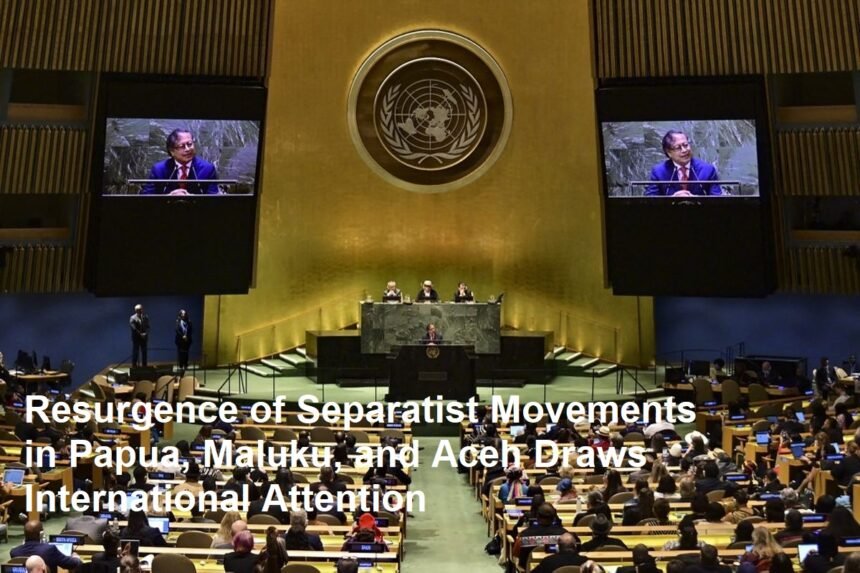
The recent appearance of slogans such as “Free Aceh,” “Free Maluku,” and “Free Papua” at the United Nations Permanent Forum on Indigenous Issues (UNPFII) has reignited global discussions about Indonesia’s long-standing separatist movements. The incident occurred during the opening session of the 24th UNPFII, scheduled to take place from April 21 to May 2, 2025, highlighting how these regional conflicts remain a sensitive and unresolved issue for the Indonesian government. While Jakarta has consistently emphasized national unity, the internationalization of these movements underscores lingering grievances and the complex interplay of historical, political, and human rights factors.

Historical Context of Separatism
The roots of separatist movements in Aceh, Papua, and Maluku trace back to Indonesia’s early years as an independent nation. Each region has distinct historical narratives of resistance, often tied to perceived marginalization, cultural identity, and resource exploitation.

  1. Aceh: Known for its strong Islamic identity, Aceh fought a decades-long insurgency led by the Free Aceh Movement (GAM), which sought independence due to grievances over central government control and unequal revenue sharing from its natural resources. The 2005 Helsinki Peace Agreement ended the conflict, granting Aceh special autonomy. However, recent tensions suggest that some groups remain dissatisfied with Jakarta’s implementation of the accord.
  2. Papua: The Papua conflict is Indonesia’s most active separatist struggle. The region, incorporated into Indonesia in 1969 via a controversial UN-backed referendum, has witnessed persistent armed resistance by groups like the Free Papua Organization (OPM). Allegations of human rights abuses by security forces, cultural marginalization of Indigenous Papuans, and discontent over the exploitation of Papua’s vast mineral resources have fueled demands for self-determination.
  3. Maluku: The South Maluku Republic (RMS) movement, which declared independence in 1950, stems from historical resistance to integration into Indonesia. While RMS activity has dwindled, sporadic demonstrations and symbolic gestures, such as raising the RMS flag, reflect enduring aspirations among some Maluku communities.

The UNPFII Incident: A Platform for Advocacy
The appearance of pro-independence slogans at the UNPFII—a forum dedicated to Indigenous rights—signals attempts by activists to globalize their struggles. Advocacy groups argue that Indigenous Papuans and other communities face systemic discrimination, environmental degradation from extractive industries, and militarization. By leveraging international platforms, they aim to pressure Indonesia through diplomatic channels and garner support for self-determination.

However, Indonesia has vehemently opposed such efforts, asserting that these movements threaten its sovereignty. The government maintains that special autonomy policies and economic development programs address regional disparities. In Papua, for instance, infrastructure projects and affirmative action policies have been prioritized, though critics argue these fail to resolve core political and human rights issues.

Government Response and National Unity
Jakarta has long treated separatism as a red line, invoking the nation’s “Unitary State of the Republic of Indonesia” (NKRI) principle. Security forces have clamped down on separatist activities, particularly in Papua, where internet shutdowns and restrictions on foreign media access are common during unrest. The government also accuses external actors, including foreign NGOs and diaspora groups, of inflaming tensions.

In response to the UNPFII incident, Indonesian officials reiterated their commitment to dialogue within the framework of NKRI. Coordinating Minister for Political, Legal, and Security Affairs Hadi Tjahjanto stated, “Indonesia’s territorial integrity is non-negotiable. We are open to addressing grievances through existing legal mechanisms, not separation.”

International Reactions and Implications
The incident has drawn mixed reactions globally. While some countries and human rights organizations support Indigenous advocacy, others, including ASEAN members, have backed Indonesia’s stance on sovereignty. The UN itself walks a delicate line, balancing its mandate to protect Indigenous rights with respect for member states’ territorial integrity.

For Indonesia, the challenge lies in addressing root causes—inequality, injustice, and cultural erosion—without compromising national unity. The government’s development-centric approach, while impactful in reducing poverty, often overlooks demands for political autonomy. Meanwhile, the militarization of conflict zones like Papua risks further alienating local populations.

Looking Ahead
As the 2025 UNPFII session approaches, Indonesia faces mounting pressure to engage constructively with Indigenous and separatist voices. A potential path forward could involve expanding autonomy packages, ensuring transparent investigations into human rights abuses, and fostering inclusive economic growth. Conversely, ignoring these issues may only amplify global scrutiny and perpetuate cycles of resistance.

The resurgence of “Free Papua,” “Free Maluku,” and “Free Aceh” slogans serves as a reminder that Indonesia’s unity is not yet set in stone. While the nation has made strides in post-conflict recovery, lasting peace will require reconciling national cohesion with the diverse aspirations of its peoples.


bankingfortunes.com
Share This Article
Twitter Email Copy Link Print
Previous Article 5 Reasons Why Trees Are Prone to Lightning Strikes: Science Behind Nature’s Giant Conductors
Next Article Ecuador Shaken by Magnitude 6.3 Earthquake
Leave a comment

Leave a Reply Cancel reply

Your email address will not be published. Required fields are marked *

World Wide

SportsWorld

Japan’s Hajime Moriyasu Chooses Stability Over Major Rotation for June 2025 Match Against Indonesia

In preparation for the upcoming international fixture against Indonesia in June 2025, Japan’s national team head coach, Hajime Moriyasu, has…

Politics

Rising Negative Sentiment Toward China in Central Europe’s Visegrad Group

In recent years, public sentiment toward China has increasingly turned negative across the Central European countries that form the Visegrad…

Politics

Pakistan’s Response to India’s Threat of Full-Scale Military Action Including Nuclear Weapons

Amid escalating tensions between India and Pakistan, Pakistan has issued a stern warning in response to India’s threat of using…

Trending On

United States to Support Ukraine Following Official Signing of New Mineral Deal as Requested by Donald Trump

On April 30, 2025, the United States and Ukraine officially signed a landmark economic partnership…

Why Newly Elected Popes Choose a New Name Upon Their Coronation

The tradition of newly elected popes adopting a new name dates back centuries and carries…

Mark Zuckerberg Declares the End of the Social Media Era Amidst FTC Antitrust Trial Against Meta

In 2025, Meta CEO Mark Zuckerberg made a striking admission during the ongoing Federal Trade…

Russian Military Drone Strike on Civilian Minibus in Sumy Kills Nine, Injures Four

On Saturday, May 17, 2025, a tragic incident unfolded in the northern Ukrainian region of…

Understanding the Corporate Transparency Act (CTA)

The meaning of the Corporate Transparency Act (CTA) is a law aimed at increasing the…

Trump Insists U.S. Is Serious About Making Canada the 51st State

On April 25, 2025, in an interview with Time magazine, President Donald Trump emphatically stated…

Japan’s Hajime Moriyasu Chooses Stability Over Major Rotation for June 2025 Match Against Indonesia

In preparation for the upcoming international fixture against Indonesia in June 2025, Japan’s national team…

Escalating Tensions: Four Days of Cross-Border Firing Between Indian and Pakistani Forces in Kashmir

The disputed region of Kashmir has once again become the focal point of geopolitical concern…

Tourists Staying in Liverpool Now Required to Pay £2 Per Night Tourist Tax

Starting recently, visitors who stay overnight in Liverpool are now required to pay a tourist…

PoliticsWorld

Plane Carrying Five People Crashes into Alligator-Infested Swamp in Amazon, Bolivia; All Successfully Evacuated

Last week, a small aircraft carrying five individuals crashed into a remote swamp area within the Amazon rainforest in Bolivia.…

3 Min Read
Politics

President Prabowo Subianto Welcomes Australian Prime Minister Anthony Albanese for Official Visit to Jakarta

On Thursday, May 15, 2025, President Prabowo Subianto of the Republic of Indonesia officially received Australian Prime Minister Anthony Albanese…

5 Min Read
PoliticsWorld

The Swift Deletion: Examining Israel’s Erroneous Condolence and its Implications

The digital age has blurred the lines between private expression and official statement. This is particularly evident in the realm…

4 Min Read
Asset Management

The main role of a Certified Public Accountant

Understanding Certified Public Accountant A Certified Public Accountant (CPA) is a financial professional who has passed the internationally recognized CPA…

10 Min Read
Investment Market

Real Cost of Capital Calculation Method

Definition of Real Cost of Capital Real Cost of Capital is a concept used in the world of finance to…

10 Min Read
Investment Market

Procedures for Calculating and Reporting Surcharge

Understanding Surcharge Surcharge is a term commonly used in the field of taxation, and can be interpreted as an addition…

8 Min Read
Politics

U.S. Vice President JD Vance Responds to German Elites’ Efforts to Dismantle Far-Right AfD Party, Comparing It to Rebuilding the Berlin Wall

In a recent statement, U.S. Vice President JD Vance addressed the ongoing political tensions in Germany surrounding the far-right Alternative…

4 Min Read
HealthWorld

5 Vitamin D Foods to Strengthen Bones and Immunity

Vitamin D is an essential nutrient that plays a crucial role in maintaining strong bones and supporting a healthy immune…

5 Min Read
bankingfortunes.com
Facebook Twitter Youtube Rss Medium

Greetings to you

BankingFortunes: Your instant connection to breaking stories and live updates. Stay informed with our real-time coverage across politics, tech, business, and more. Your reliable source for 24/7 news.

Top Categories
  • About Us
  • Contact Us
  • Privacy Policy
  • Terms of Use
  • Economic Policies
  • Investment Market
  • Financial Context
  • World
  • Politics
  • Sports
  • Economy
  • Technology
  • Health
  • Asset Management

Address

Bahnhofstrasse 26A, 8001 Zürich, Switzerland. +41 44 220 15 17

© BankingFortunes Network.  2019 – 2025. All Rights Reserved.

Welcome Back!

Sign in to your account

Lost your password?