
• Home
  • About Us
  • Contact
  • Term Of Use
  • Privacy Policy
Subscribe
bankingfortunes.com
  • Home
  • Economic Policies
  • Investment Market
  • Financial Context
  • Asset Management
  • Politics
  • Sports
  • Technology
  • Health
  • Contact Us
    • Terms of Use
    • About Us
    • Privacy Policy
🔥
  • Top stories
Aa
bankingfortunes.combankingfortunes.com
  • My Saves
  • My Interests
  • My Feed
  • History
Search
  • Pages
    • Home
    • Blog Index
    • Contact Us
    • Search Page
    • 404 Page
  • Home
    • Home 1
    • Home 2
    • Home 3
    • Home 4
    • Home 5
  • Home
    • Home 1
    • Home 2
    • Home 3
    • Home 4
    • Home 5
  • Home
    • Home 1
    • Home 2
    • Home 3
    • Home 4
    • Home 5
  • Home
  • Home
  • Categories
  • Categories
  • Demos
  • Personalized
    • My Feed
    • My Saves
    • My Interests
    • History
  • Demos
  • Demos
  • More Foxiz
    • Blog Index
    • Forums
    • Complaint
    • Sitemap
  • Categories
  • More Foxiz
    • Blog Index
    • Forums
    • Complaint
    • Sitemap
  • Categories
  • Categories
  • Categories
  • Bookmarks
  • Bookmarks
  • Bookmarks
  • More Foxiz
    • Sitemap
  • More Foxiz
    • Sitemap
  • More Foxiz
    • Sitemap
Have an existing account? Sign In
Follow US
© 2022 Foxiz News Network. Ruby Design Company. All Rights Reserved.
bankingfortunes.com > Blog > World > 5 Reasons Why Trees Are Prone to Lightning Strikes: Science Behind Nature’s Giant Conductors
World

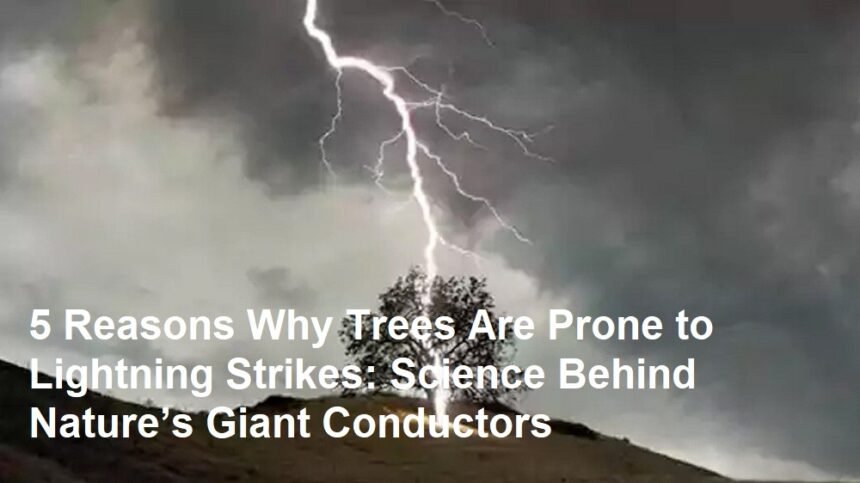
5 Reasons Why Trees Are Prone to Lightning Strikes: Science Behind Nature’s Giant Conductors

5 Min Read
SHARE

Lightning strikes are a powerful and often destructive force of nature, with trees frequently acting as unintended lightning rods. While thunderstorms electrify the skies, certain trees become prime targets due to a mix of biological, environmental, and physical factors. Here are five key reasons why trees are vulnerable to lightning strikes, unraveling the science behind this phenomenon.

  1. Height and Prominence: The Tallest Target Wins

Trees, especially those towering above their surroundings, naturally attract lightning. Lightning seeks the shortest path to the ground, and tall objects—like mature oaks, pines, or redwoods—provide an ideal conduit. A study by the National Severe Storms Laboratory (NSSL) found that 70% of lightning strikes hit objects taller than 10 meters (33 feet). In forests, the tallest trees act as natural lightning rods, diverting strikes away from shorter vegetation. However, isolated trees in open fields or hilltops face even greater risks, as their prominence leaves them unprotected by neighboring structures.

  1. High Moisture Content: Nature’s Conductor

Water is an excellent conductor of electricity, and trees with high moisture content—whether from sap, internal water reserves, or rain-soaked bark—are more likely to channel lightning. During storms, rainwater accumulates on leaves and bark, creating a conductive pathway from the sky to the roots. Species like willows and poplars, which thrive in wet environments, are particularly susceptible. Even a tree’s internal structure plays a role: moist, living tissues beneath the bark offer less resistance to electrical currents than dry, dead wood.

  1. Species-Specific Traits: Bark and Sap Matter

Not all trees are equally prone to lightning strikes. Species with rough, deeply grooved bark, such as oaks, tend to suffer more frequent strikes than smooth-barked trees like beeches. The grooves trap moisture and create pathways for electrical currents. Additionally, resinous trees like pines may explode upon impact due to flammable sap, though their sticky resin doesn’t necessarily attract strikes. Conversely, palm trees, with their fibrous, water-rich trunks, are common lightning victims in tropical regions.

  1. Isolation: No Shelter from the Storm

A tree standing alone in a field, pasture, or urban park lacks the protective buffer of a forest canopy. Lightning is less likely to strike clustered trees because the charge disperses among multiple targets. Isolated trees, however, become the sole focal point for electrical discharge. This explains why historic “loner” trees, such as the 2,000-year-old Angel Oak in South Carolina, often bear lightning scars. Urban planners sometimes install lightning rods on such trees to mitigate damage.

  1. Location and Topography: High Ground Equals High Risk

Trees growing on elevated terrain—hilltops, ridges, or mountain slopes—are exposed to stronger electrical fields during storms. Lightning tends to strike the highest point in a landscape, making these trees vulnerable. Proximity to water bodies, such as lakes or rivers, also increases risk. Humid microclimates near water enhance storm intensity, while the moist soil improves grounding, creating an efficient circuit for lightning to follow into the earth.

The Aftermath: Why Lightning Damage Varies

When lightning strikes a tree, the results range from superficial bark scars to catastrophic explosions. The tree’s moisture content determines the severity: rapid vaporization of internal water can rupture trunks, while drier trees may survive with minimal damage. Root systems also play a role—trees with deep, extensive roots safely dissipate energy into the ground, whereas shallow-rooted species may suffer root zone destruction.

Broader Implications: Ecology and Human Safety

Lightning-struck trees contribute to forest ecosystems by creating deadwood habitats for wildlife, but they also pose risks. Falling limbs or fires ignited by strikes threaten nearby structures. To reduce hazards, experts recommend installing lightning protection systems on valuable or historic trees and avoiding sheltering under isolated trees during storms.

Conclusion: Nature’s Electric Balancing Act

Trees, while essential to ecosystems, are caught in a delicate dance with lightning—a reminder of nature’s raw power. Understanding these five factors helps arborists, landscapers, and communities mitigate risks while appreciating the complex interplay between biology and atmospheric forces. As climate change intensifies storm patterns, the science of lightning and trees will only grow more critical.


bankingfortunes.com
Share This Article
Twitter Email Copy Link Print
Previous Article USTR Renewed Criticism of Indonesia’s Nickel Ore Export Ban
Next Article Resurgence of Separatist Movements in Papua, Maluku, and Aceh Draws International Attention
Leave a comment

Leave a Reply Cancel reply

Your email address will not be published. Required fields are marked *

World Wide

Historic $142 Billion Arms Deal Signed Between United States and Saudi Arabia

On Tuesday, May 13, 2025, the United States and Saudi Arabia formalized what is being hailed as the largest arms…

Politics

India’s Water Threat to Pakistan and China’s Role in Crisis Mitigation

In 2025, the long-standing tensions between India and Pakistan have escalated into a critical water dispute, with India threatening to…

PoliticsWorld

The Swift Deletion: Examining Israel’s Erroneous Condolence and its Implications

The digital age has blurred the lines between private expression and official statement. This is particularly evident in the realm…

Trending On

Donald Trump Orders Rebuilding and Reopening of Alcatraz Prison

On May 4, 2025, former U.S. President Donald Trump announced his directive to rebuild and…

Rising Negative Sentiment Toward China in Central Europe’s Visegrad Group

In recent years, public sentiment toward China has increasingly turned negative across the Central European…

3 Data-Driven Strategies to Decode Consumer Behavior and Skyrocket Sales

Introduction In today’s hypercompetitive market, understanding consumer behavior is the cornerstone of boosting sales and…

Istanbul Shaken by Magnitude 6.2 Earthquake: A Preliminary Assessment

On Thursday, April 23, 2025, Istanbul, Turkey, experienced a significant seismic event as a magnitude…

Ahead of the Conclave, 133 Cardinals to Be Isolated at Domus Sanctae Marthae

As the Catholic Church prepares for the upcoming papal Conclave, 133 cardinals from around the…

The main role of a Certified Public Accountant

Understanding Certified Public Accountant A Certified Public Accountant (CPA) is a financial professional who has…

Peruvian National Team Welcomes the Election of Cardinal Robert Francis Prevost as Pope Leo XIV

In a remarkable and historic moment for the global Catholic community, Cardinal Robert Francis Prevost…

Nissan Motor Announces 20,000 Job Cuts Amid $4.5 Billion Net Loss and Restructuring Plan

Nissan Motor Company, one of the world’s leading automobile manufacturers, has recently announced a significant…

Spain Cancels Controversial $7.5 Million Ammunition Deal with Israel Amid Political Backlash

MADRID, April 24, 2025 — Spain’s government announced on Thursday it has terminated a contentious…

PoliticsTechnology

China’s New Deep-Sea Cable Cutter: A Game-Changing Weapon Capable of Severing Undersea Communication Infrastructure at 4000 Meters Depth

China has unveiled a powerful new weapon designed to cut underwater communication cables at depths of up to 4000 meters…

4 Min Read
Financial Context

Legality and Government Regulations Regarding Shell Corporation

Understanding Shell Corporation Shell Corporation is a business entity that has no significant assets, operations or business activities. Usually, these…

8 Min Read
EconomyWorld

Tourists Staying in Liverpool Now Required to Pay £2 Per Night Tourist Tax

Starting recently, visitors who stay overnight in Liverpool are now required to pay a tourist tax of £2 per night.…

4 Min Read
Health

Natural Kidney Detox: 3 Effective Drinks for Removing Toxins

Maintaining healthy kidneys is essential for overall well-being, as these vital organs filter waste and toxins from the bloodstream, regulate…

5 Min Read
EconomyPolitics

Navigating Geopolitical Tides: Indonesia’s Economic Balancing Act with China and the US

Indonesia, under the leadership of Coordinating Minister for Economic Affairs Airlangga Hartarto, finds itself navigating a complex geopolitical landscape where…

4 Min Read
EconomyWorld

Japanese Agriculture Minister Taku Eto Apologizes for “Never Needed to Buy Rice” Remarks Amid Price Protests

On Monday, May 19, 2025, Japan’s Agriculture Minister Taku Eto issued a public apology following widespread backlash over his controversial…

7 Min Read
Health

5 Morning Symptoms of Diabetes That Are Often Overlooked

Diabetes is a chronic condition characterized by elevated blood sugar levels due to the body’s inability to produce or effectively…

5 Min Read
World

Thousands Pay Nocturnal Tribute as Pope Francis Lies in State at St. Peter’s Basilica

VATICAN CITY — In a profound display of reverence, nearly 20,000 pilgrims gathered under the moonlit sky to pay their…

5 Min Read
bankingfortunes.com
Facebook Twitter Youtube Rss Medium

Greetings to you

BankingFortunes: Your instant connection to breaking stories and live updates. Stay informed with our real-time coverage across politics, tech, business, and more. Your reliable source for 24/7 news.

Top Categories
  • About Us
  • Contact Us
  • Privacy Policy
  • Terms of Use
  • Economic Policies
  • Investment Market
  • Financial Context
  • World
  • Politics
  • Sports
  • Economy
  • Technology
  • Health
  • Asset Management

Address

Bahnhofstrasse 26A, 8001 Zürich, Switzerland. +41 44 220 15 17

© BankingFortunes Network.  2019 – 2025. All Rights Reserved.

Welcome Back!

Sign in to your account

Lost your password?