
• Home
  • About Us
  • Contact
  • Term Of Use
  • Privacy Policy
Subscribe
bankingfortunes.com
  • Home
  • Economic Policies
  • Investment Market
  • Financial Context
  • Asset Management
  • Politics
  • Sports
  • Technology
  • Health
  • Contact Us
    • Terms of Use
    • About Us
    • Privacy Policy
🔥
  • Top stories
Aa
bankingfortunes.combankingfortunes.com
  • My Saves
  • My Interests
  • My Feed
  • History
Search
  • Pages
    • Home
    • Blog Index
    • Contact Us
    • Search Page
    • 404 Page
  • Home
    • Home 1
    • Home 2
    • Home 3
    • Home 4
    • Home 5
  • Home
    • Home 1
    • Home 2
    • Home 3
    • Home 4
    • Home 5
  • Home
    • Home 1
    • Home 2
    • Home 3
    • Home 4
    • Home 5
  • Home
  • Home
  • Categories
  • Categories
  • Demos
  • Personalized
    • My Feed
    • My Saves
    • My Interests
    • History
  • Demos
  • Demos
  • More Foxiz
    • Blog Index
    • Forums
    • Complaint
    • Sitemap
  • Categories
  • More Foxiz
    • Blog Index
    • Forums
    • Complaint
    • Sitemap
  • Categories
  • Categories
  • Categories
  • Bookmarks
  • Bookmarks
  • Bookmarks
  • More Foxiz
    • Sitemap
  • More Foxiz
    • Sitemap
  • More Foxiz
    • Sitemap
Have an existing account? Sign In
Follow US
© 2022 Foxiz News Network. Ruby Design Company. All Rights Reserved.
bankingfortunes.com > Blog > Economy > Japanese Agriculture Minister Taku Eto Apologizes for “Never Needed to Buy Rice” Remarks Amid Price Protests
EconomyWorld

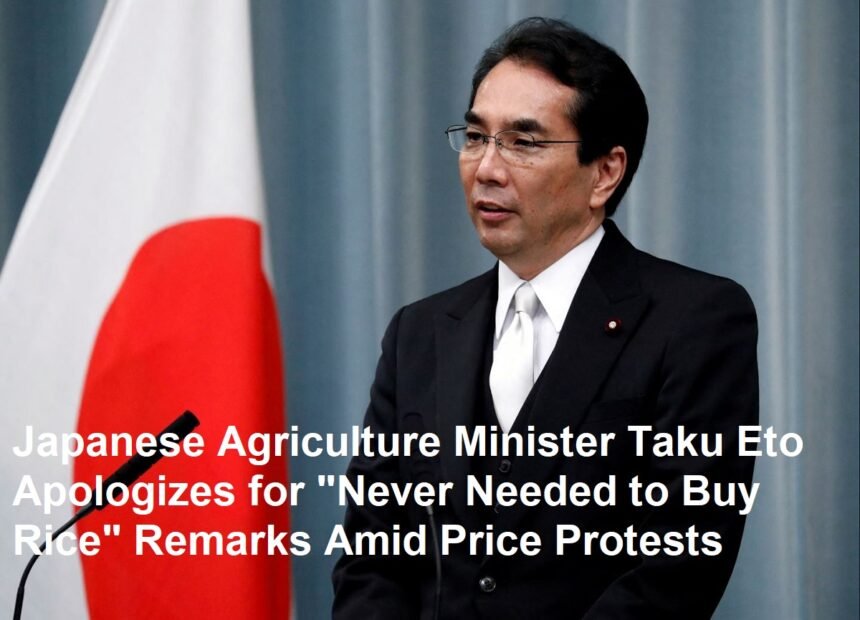
Japanese Agriculture Minister Taku Eto Apologizes for “Never Needed to Buy Rice” Remarks Amid Price Protests

7 Min Read
SHARE

On Monday, May 19, 2025, Japan’s Agriculture Minister Taku Eto issued a public apology following widespread backlash over his controversial statement that he “never needed to buy rice.” The remark came at a time when many Japanese citizens are grappling with rising rice prices, sparking protests and concerns about food affordability. The incident has drawn significant attention to Japan’s agricultural policies and the political sensitivity surrounding staple food prices in the country.

Context of Rising Rice Prices and Public Concerns

In recent months, Japan has experienced a notable increase in rice prices, driven by a combination of factors including adverse weather conditions affecting harvests, rising production costs, and global supply chain disruptions. Rice, being a fundamental part of the Japanese diet and culture, holds a special place in the public consciousness. The price hikes have placed financial strain on many households, particularly those with lower incomes and elderly populations who rely heavily on rice as a dietary staple.

The government’s agricultural policies, including subsidies and import regulations, have long aimed to protect domestic rice farmers and maintain stable prices. However, the recent surge in prices has led to growing dissatisfaction among consumers, who have voiced their concerns through protests and social media campaigns demanding government intervention to control costs and ensure food security.

Minister Taku Eto’s Controversial Statement

Amid this tense atmosphere, Minister Taku Eto made a statement during a press briefing on May 19, 2025, that ignited public outrage. He remarked that he “never needed to buy rice,” implying a disconnect from the everyday struggles faced by ordinary citizens. The comment was perceived as insensitive and out of touch, especially given the ongoing price protests and the economic challenges confronting many Japanese families.

The statement quickly went viral, prompting criticism from opposition politicians, consumer advocacy groups, and the general public. Many accused the minister of lacking empathy and understanding of the real impact of rising food prices on the population.

Public Reaction

The backlash was swift and widespread. Protesters gathered outside the Ministry of Agriculture offices, demanding a formal apology and concrete measures to address the rice price issue. Social media platforms were flooded with messages condemning the minister’s remarks, with hashtags calling for his resignation trending nationwide.

Consumer groups highlighted the importance of government officials demonstrating awareness and sensitivity to citizens’ hardships, especially regarding essential goods like rice. The controversy also reignited debates about the effectiveness of Japan’s agricultural policies and the need for reforms to balance farmer support with consumer protection.

Minister Eto’s Apology

In response to the mounting criticism, Minister Taku Eto issued a public apology later on May 19, 2025. He stated:

“I deeply regret my recent remarks suggesting that I have never needed to buy rice. It was an insensitive comment that does not reflect my understanding of the difficulties many Japanese families are currently facing due to rising rice prices. I sincerely apologize to the public for any offense caused. As Minister of Agriculture, I am committed to working diligently to address these concerns and ensure that rice remains affordable and accessible to all.”

Political Implications

The incident has significant political ramifications for the ruling government, which is already under pressure to manage inflation and economic challenges. Minister Eto’s comments have been seized upon by opposition parties as evidence of the administration’s disconnect from ordinary citizens. The controversy may weaken public trust in the government’s ability to handle food security and agricultural issues effectively.

Furthermore, the episode underscores the delicate balance policymakers must maintain between supporting domestic farmers and protecting consumers from price volatility. It also highlights the importance of communication and empathy from public officials in maintaining public confidence.

Historical Context of Rice Policy in Japan

Japan’s rice policy has historically been characterized by protectionism, with strict import controls and subsidies designed to preserve domestic production and rural livelihoods. Rice farming is deeply embedded in Japanese culture and tradition, and the government has long prioritized self-sufficiency in this staple crop.

However, these policies have sometimes led to higher prices compared to global markets, sparking debates about the need for liberalization and modernization. The current price surge and public discontent reflect ongoing tensions between maintaining traditional agricultural practices and adapting to contemporary economic realities.

Potential Policy Changes Following the Controversy

In the wake of the controversy, there are growing calls for the government to review and possibly reform its rice policies. Potential measures include increasing subsidies to offset production costs, enhancing support for farmers to improve yield and efficiency, and exploring ways to stabilize prices through strategic reserves or import adjustments.

Additionally, the government may seek to improve transparency and communication with the public to rebuild trust. Minister Eto’s apology and commitment to action suggest that the administration recognizes the urgency of addressing both the economic and social dimensions of the rice price issue.


In conclusion, Minister Taku Eto’s public apology for his “never needed to buy rice” remarks comes at a critical juncture for Japan’s agricultural sector and food policy. The incident has brought to light the challenges faced by consumers amid rising prices and the political sensitivity surrounding staple food affordability. Moving forward, effective policy responses and empathetic leadership will be essential to restore public confidence and ensure food security in Japan.

bankingfortunes.com
Share This Article
Twitter Email Copy Link Print
Previous Article China’s LandSpace Successfully Launches Methane-Powered Zhuque-2E Y2 Rocket, Deploying Six Satellites into Orbit
Next Article China Unveils Jiu Tian: The Versatile Mother Drone for Tactical Operations and Drone Swarms
Leave a comment

Leave a Reply Cancel reply

Your email address will not be published. Required fields are marked *

World Wide

PoliticsTechnologyWorld

Bill Gates’ Reaction to Indonesia’s Plan to Build a Nuclear Power Plant

Indonesia’s recent announcement to develop a nuclear power plant marks a significant step in the country’s pursuit of sustainable and…

World

Vatican Announces Timeline for Conclave to Elect Successor to Pope Francis

VATICAN CITY — The Vatican has confirmed that the conclave to elect the successor to Pope Francis will commence on…

PoliticsWorld

European Leaders Urge 30-Day Ceasefire During Kyiv Visit

On May 10, 2025, four prominent European leaders—United Kingdom’s Prime Minister Keir Starmer, France’s President Emmanuel Macron, Germany’s Chancellor Friedrich…

Trending On

Tottenham Hotspur’s Historic Victory in the 2024/2025 UEFA Europa League

On May 22, 2025, Tottenham Hotspur made history by winning the UEFA Europa League for…

India’s Water Threat to Pakistan and China’s Role in Crisis Mitigation

In 2025, the long-standing tensions between India and Pakistan have escalated into a critical water…

India-Pakistan Border Conflict Claims 41 Lives Amid Escalating Tensions

The longstanding conflict between India and Pakistan has once again escalated into deadly violence along…

Pakistan Becomes Second Most Trending Topic on X for Five Hours with 6.4 Million Tweets

On May 7, 2025, Pakistan emerged as the second most trending topic on X, the…

Germany’s Domestic Intelligence Agency (BFV) Labels Far-Right Alternative for Germany (AfD) as an Extremist Group

In a significant development in German politics, the Federal Office for the Protection of the…

Pakistan’s Response to India’s Threat of Full-Scale Military Action Including Nuclear Weapons

Amid escalating tensions between India and Pakistan, Pakistan has issued a stern warning in response…

The Implications of Israel’s Announcement on the Killing of Hamas Leader Mohammed Sinwar

On Wednesday, May 21, 2025, Israeli Prime Minister Benjamin Netanyahu publicly declared that Israeli forces…

How to Reduce Unsystematic Risk

Unsystematic Risk is a risk that arises as a result of problems or events that…

Industry Position and its Relationship to Market Share

Understanding Market Share Market share is a term used to refer to a specific share…

Economy

Global Economy Faces Grim Outlook as 48 Countries Turn to IMF for Support

The global economic landscape is increasingly bleak, with mounting challenges pushing nearly 48 countries to seek assistance from the International…

5 Min Read
Asset Management

Reasons and Objectives of Wage Garnishment

Wage garnishment is a legal action that can be applied by creditors against debtors who fail to pay debt payments…

9 Min Read
World

Thai Construction Tycoon and Associates Surrender to Police Over Alleged Faulty Construction Causing Building Collapse After March Earthquake

On Friday, May 16, 2025, a prominent construction conglomerate leader in Thailand, along with more than a dozen others, voluntarily…

4 Min Read
Investment Market

Analysis of Real Conjuncture Theory in Economic Practice

Definition of Real Conjuncture Theory Real Conjuncture Theory refers to an approach in macroeconomics, which studies short-term fluctuations in the…

9 Min Read
Technology

Tech Giant Huawei Partners with AI Innovator Deepseek to Accelerate Artificial Intelligence Development

Huawei Technologies, one of the world’s leading technology companies, has announced a strategic partnership with Deepseek, a cutting-edge artificial intelligence…

5 Min Read
World

The Paradox of Protest: Vandalism and the Climate Crisis in SoHo

On Tuesday, April 22nd, 2025, a stark manifestation of escalating tensions surrounding climate action and technological progress played out in…

4 Min Read
PoliticsWorld

Plane Carrying Five People Crashes into Alligator-Infested Swamp in Amazon, Bolivia; All Successfully Evacuated

Last week, a small aircraft carrying five individuals crashed into a remote swamp area within the Amazon rainforest in Bolivia.…

3 Min Read
Politics

Rising Negative Sentiment Toward China in Central Europe’s Visegrad Group

In recent years, public sentiment toward China has increasingly turned negative across the Central European countries that form the Visegrad…

5 Min Read
bankingfortunes.com
Facebook Twitter Youtube Rss Medium

Greetings to you

BankingFortunes: Your instant connection to breaking stories and live updates. Stay informed with our real-time coverage across politics, tech, business, and more. Your reliable source for 24/7 news.

Top Categories
  • About Us
  • Contact Us
  • Privacy Policy
  • Terms of Use
  • Economic Policies
  • Investment Market
  • Financial Context
  • World
  • Politics
  • Sports
  • Economy
  • Technology
  • Health
  • Asset Management

Address

Bahnhofstrasse 26A, 8001 Zürich, Switzerland. +41 44 220 15 17

© BankingFortunes Network.  2019 – 2025. All Rights Reserved.

Welcome Back!

Sign in to your account

Lost your password?